
The image we share is **Korzybski’s Fig. 1**, the *structural differential*. It appears on p. 387 of *Science and Sanity* (first published in October, 1933; 3rd ed., with new preface, 1948/ 3rd large pr. 1950) and is immediately followed on p. 388 by the section titled **“VII. The Mechanism of Time-Binding.”** These two pages together present the canonical diagram and its interpretation. They are the closest thing Korzybski ever gives to a *formal model* of human abstraction.
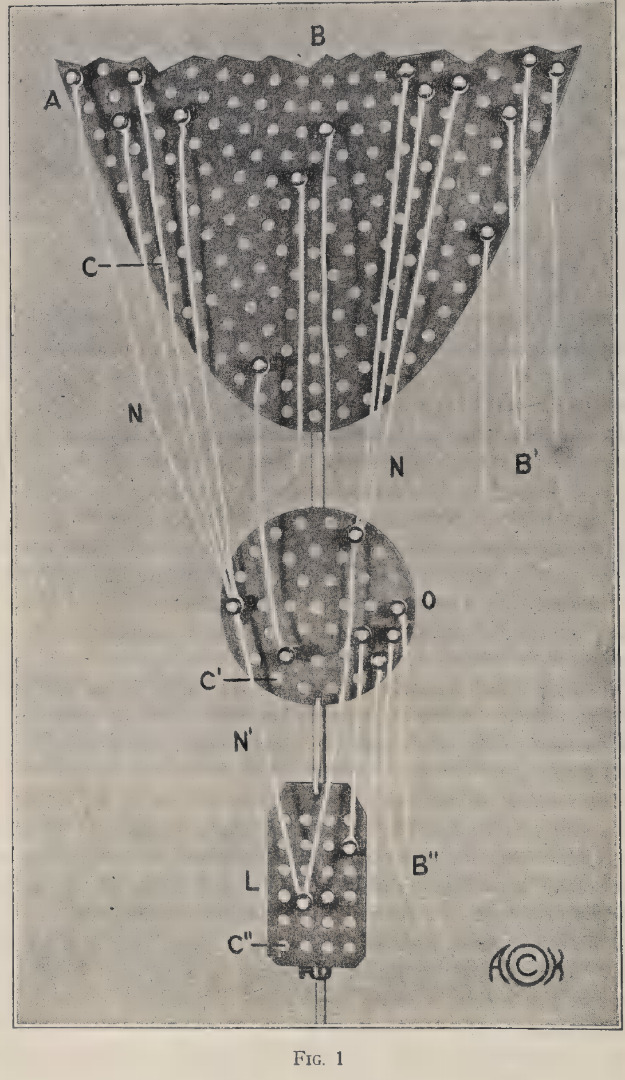
The structural differential
## **What the diagram shows** At the top sits the **Event**—the unspeakable, sub-microscopic, dynamic world (the region labeled B, perforated with innumerable holes). Korzybski emphasizes that this level is *infinite* in characteristics, overwhelmingly richer than anything a nervous system can register. In Fig. 1 the event is drawn as a fluttering, irregular cloud-like sheet whose surface is dotted with holes, each a “characteristic.”
> In our diagram, Fig. 1, we indicate this by a parabola (A), which is supposed to extend indefinitely, which extension we indicate by a broken off line (B). We symbolize the characteristics by small circles (C), the number of which is obviously indefinitely great.
From this Event level, **strings** descend. Each string marks a *causal path* along which some characteristics are transmitted to the next level through the senses. These strings are not the characteristics themselves but *correspondences*—selection lines marking what the organism can respond to. Below the Event sheet hangs a disk, the **Object** level. It is also covered in holes, but fewer in number. This level represents what the nervous system can register: a reduced set of characteristics, a selection from the Event. Korzybski calls this the **first abstraction**. From the Object level, still more strings descend. They lead to the lower rectangular plate, the **Label** level. This is language: names, descriptions, classifications. Its holes are again fewer, and its arrangement more angular. This is the **second abstraction**, abstraction-from-abstraction. Below the Label plate hangs further discs and plates (e.g., L, C″) representing successive **higher-order abstractions**. The strings descending become ever sparser: each abstraction orders, selects, and discards. The entire apparatus is not a model of “mind”; it is a map of *structural relations*. Korzybski insists: the diagram is a **differential**—something that *subtracts characteristics* at each stage of abstraction.
--- ## **What Korzybski explains on page 388 (“The Mechanism of Time-Binding”)** Immediately after presenting the figure, he explains its function. Time-binding, he writes, is not memory, not culture, not intellect, but the **ability to build higher-order abstractions upon lower ones**, in a cumulative, transmissible sequence. Humans are the only class of life for which this is structurally possible. Where the animal’s chain ends at something like Object → Reaction, the human chain continues: Event → Object → Labels → Descriptions → Theories → Sciences → Institutions → Tools → Traditions → Mathematics → Engineering → Futures-not-yet-existent. Each stage incorporates the results of previous stages and becomes **material for the next abstraction**. This accumulated layering is what he calls *binding time*: binding the work of past generations into the possibilities of present and future generations. To formalize this, he uses the structural differential to show that: 1. abstraction is **ordered** 2. abstraction is **lossy** (structural non-identity at each step) 3. abstraction is **recursive** 4. abstraction produces **structures that can be further abstracted** This is precisely the mechanism of time-binding. Korzybski writes that time-binding depends on humans being able to **abstract from their own abstractions**. That is the entire point of the lower plates in the figure. And he notes that because abstractions accumulate culturally, the human species advances not arithmetically (as animals do) but **geometrically**. The structural differential is therefore both a *cognitive theory* and a *sociological theory* encoded in one diagram.